
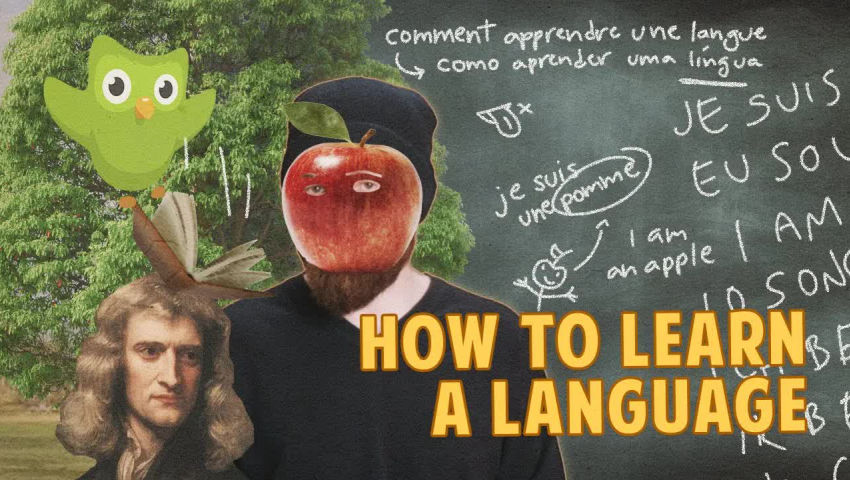
I once had something like a 700 day streak on Duolingo Spanish. But I still didn’t feel like I was learning all that much.
So then I decided to try going to a local spanish language learning meetup group. My spanish was awful, but I figured that if I just kept showing up then eventually I’d learn something. And it was a good way to get out of the house and meet people. And the people in the group were great in that they had other suggestions on ways to learn. They recommended some youtube channels, and making flashcards, getting the book about spanish verbs, taking classes, or going on tailored spanish immersion trips to other countries - and this was all great!
But then a friend who had also been trying to learn spanish recommended something else to me. And I remembered it was something the spanish meetup group people had recommended too. So I went and looked this thing up, and read their philosophy, and it made so much sense.
The way that humans learn languages doesn’t change between infants and adults. So how do infants learn their native language?
First, they listen. A LOT. Adults speak to infants in a simplified language with context clues, and then the infant spends the rest of their time passively listening to the sounds others around them make. Over time, they learn that certain words are associated with certain actions or objects. And then after more time, they learn that words are associated with more abstract ideas, which can form complex and nuanced sentences.
After they have been listening to adults talk for literally years, they start speaking their first words. Their understanding of language grows as they see how others respond to their speech, and they adjust accordingly.
After a few years of practicing speaking, they learn how to read. And not long after that, they learn how to write.
There are a couple key concepts here.
First is that we want to learn to relate words in our target language directly to concepts - not to relate them to words in our native language. It is obviously much easier and more natural to understand that manzana is the concept of an apple, rather than translating spanish manzana to english apple to the concept of an apple.
Second is the concept of comprehensible input. Listening or reading the target language in a way that is understandable to you right now at the level you are at.
Third is that in order to understand native speakers, you must listen to native speakers. You will not understand Chilean spanish if you only ever listen to perfect textbook-approved spanish sentances.
Forth is that language learners should intentionally delay speaking, reading, or writing in their language learning progression for quite a while, because they will just pick up bad habits. Like if you are struggling to figure out how to say something and figure out how to say it in a really roundabout way, that weird phrasing may stick around long after you have learned a more natural way to say the same thing. Or if you learn a new word through reading, you will often mispronounce it, while listening to native speakers pronounce the word provides little ambiguity. And besides these setbacks, reading, writing, and speaking your target language before you have a firm grasp of listening will typically take the form of concept -> your native language word -> your target language word - which will not help you learn nearly as quickly as simply listening to more comprehensible input.
So how do you actually learn a language?.
The best method is cross talk. This is where you and a partner who speaks your target language natively spend time having conversations where you both speak your native language. Each person’s skill at their target language level doesn’t really matter, since each person can adjust sentence complexity and use gestures and props and other tools to communicate in a comprehensible way. But obviously, this method has a few pitfalls.
First, as a beginner it can be difficult to find a partner. More advanced speakers may want to find a match in their level, while other beginners may become easily frustrated. There are apps like Tandem which can pair you with other people around the world, but most of these people have not heard of crosstalk and won’t be interested in it - they will insist on wanting to speak their target language. And if you do find a partner on one of these apps who is interested in the crosstalk method, it is still sub-optimal, because beginner crosstalk benefits a lot from being in-person and being able to gesture, use props, and draw on pads of paper or whiteboards, while lag in your connection can make understanding them and keeping up with their screen difficult and frustrating.
So as a beginner, you could pay for a tutor to do crosstalk with you, or pay for a class where they will pair you up with another student, and an instructor can help the two of you work through frustrating communication barriers with encouragement and cleaver techniques. However, this can be quite expensive.
Finally, meeting up with someone to practice your chosen language is time consuming. It takes hundreds of hours of consuming comprehensible input to become just passable at listening to simple sentences. If you meet up with your crosstalk partner for 3 hours per day twice per week, you are still only learning at a snail’s pace.
The solution? Consume content that is designed for language learners at your level. Then you can watch 30 minutes of videos per day if that’s what fits in your schedule, or you can watch 3 hours of videos if you have a long train ride or something. Or if you are super dedicated to learning, you can watch 10 hours per day of content or more if your brain can handle it!
After doing this for about a year, I made more progress in learning spanish than I did for years using other methods. Enough that friends would point to me as “the gringo who knows spanish” when they needed a translator. I’m still only at the level of, like, a 5 year old - but holy shit! Something that actually works!
The service I used/use is called Dreaming Spanish. They regularly upload new videos for free to youtube, but they also have a website where you can make an account and track how much content you have consumed, so you have a decent idea of when you can level up. They also have a paid tier, which is (imo) reasonably priced, and gives you access to more videos (their sneaky trick is to make one video in a series free to get you hooked on the idea of the series, then paywall the rest of the series to entice you to pay). But while they obviously want you to pay them, they also often recommend other services and content creators who will help you learn just as well. From what I can tell, it is just some spanish guy who started making youtube videos, and then taught himself html, made a website, and hired a few people from other countries to make videos with him. And they also recently branched out, and started Dreaming French as well.
I know this sounds like an ad - but fuck it, I’ll totally schill for those guys! I actually fucking learned spanish, and it was fun and easy.
This is so logical and simple that I’m beside myself on how it isn’t the default solution.
Yeah - I think the reason is twofold.
First, this method doesnt really fit into the traditional classroom setting very well - people will learn the language over time using this method, but will learn different things at different speeds. You can’t test people on vocab and grammar if their assigned work is simply “listen to these people speak and try to understand the gist”. So you can find private instructors who use these methods (and in other countries, it is the default method for teaching english) - but in schools or government-sanctioned courses, it would never fly.
Second, people want to speak. Actually speaking the language and having a conversation in it is what they feel like progress should look like. So when you tell them that they won’t speak the language until they have consumed something like 1000 hours of content, they tend to write the method off. This is especially true if they have a deadline to meet - like they want to learn a language before a trip to another country. But really, in that case, you should simply get a traveller’s phrasebook and memorize a few phrases. You probably won’t make meaningful progress in learning a language in 4 weeks (or whatever) before your trip anyway.
This was super helpful to me! I’m a very casual language learner and dont have much access to in-person stuff in general. I just recently broke my Japanese streak, and I’m deciding if I wanna keep with Japanese or learn Spanish given current events here in the US
No idea if I’ll find a way to implement what you’ve explained but its my only exposure to the idea of cross talk or this perspective on language learning
Thanks for taking the time to type all this out!
I mean, if you want to learn spanish, try dreaming spanish.
For Japanese - iirc, Tandem has a paid tier where it will show you people who are nearby you? So maybe try finding some Japanese speakers near you, and pitch crosstalk to them. Maybe one or two will become consistent language learning partners, and you’ll make friends in addition to learning Japanese.
Duolingo will never be enough, but can be a good fun start and also a way of keeping always some contact with the language. But to really master a language you’ll need multiple tools and sources, there are no miracles… it’s all about repetition, exposure, daring to speak… and above all, use the language. If you master a language and then stop using it, it will fade away.