
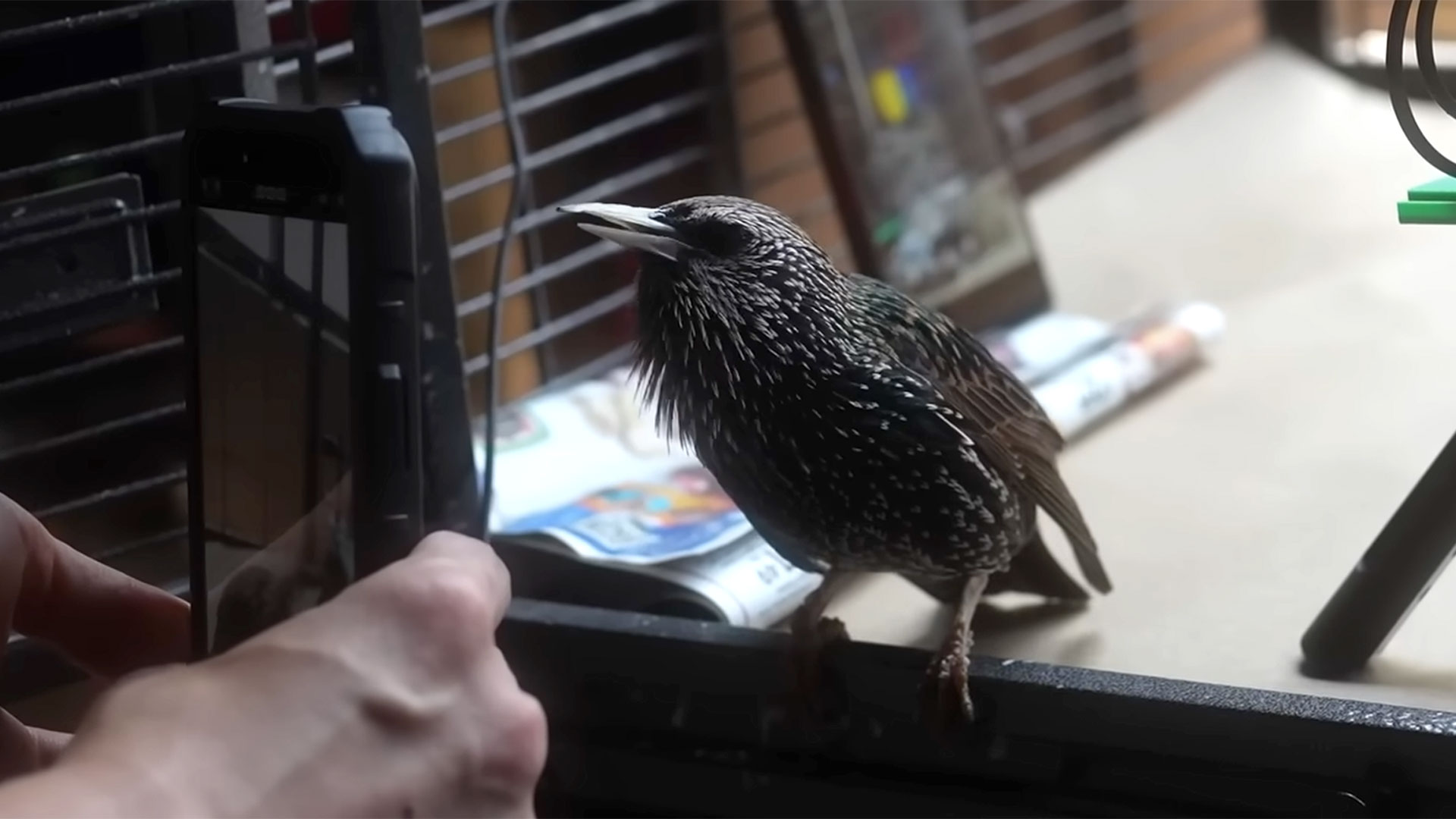
A music and science lover has revealed that some birds can store and retrieve digital data. Specifically, he converted a PNG sketch of a bird into an audio waveform, then tried to embed it in the song memory of a young starling, ready for later retrieval as an image. Benn Jordan made a video of this feat, sharing it on YouTube, and according to his calculations, the bird-based data transfer system could be capable of around 2 MB/s data speeds.
That’s not really how it works in the real world. Usually you have both bandwidth and noise constraints.
Sure you can send something like a square wave but this isn’t practical for real communication channels. Typically you’re sending many sine waves in parallel with multiple amplitudes and phase offsets to represent a sequence of bits (QAM). Then on top of that you’d encode the original data with both a randomizer (to prevent long runs from looking like nothing) and error correction. So usually the system can handle some level of distortion.
What you’re hoping is that by the time the data reaches the user (really, Layer 3), all the errors have already been handled and you never see any issues.
The bird is just another type of noisy channel with its own distortion characteristics.
The point is that at the physical layer you still have a well defined log likelihood test to produce digital information. That’s why QAM lasted so long even though it is not power efficient - because it has an analytical likelihood function.
This is the boundary between digital and analog communications. Since he did not use a digital modulation scheme, this would be a form of analog comms
You are not addressing my critique of your statement, just piling on a bunch of useless extra knowledge just so that you can feel superior.